
The Row label compared to Bottega Veneta: Contrasting Quiet Luxury Icons
Quiet luxury operates by its own vocabulary, and two houses authored much of that language. The Row and Bottega Veneta both deal in understatement instead of branding, structure over trend, and cost levels that repay considered choices instead of snap decisions. Even so, the paths each house takes toward minimalism diverge, and this difference is worth noting if you’re deciding where to spend four-figure sums on a bag or a coat. An American ready-to-wear outlook, built around tailoring and pure fabrics, drives The Row. Bottega Veneta, an Italian house, built its identity on leather craft, specifically the intrecciato weave that became shorthand for understated wealth. Shoppers researching either name are usually comparing philosophies as much as products, so this piece looks at both with equal weight before narrowing in on where The Row pulls ahead.
Brand Origins and Design Philosophy
The Row was founded in 2006 by Mary-Kate and Ashley Olsen, who left behind the fast-fashion instincts of their earlier ventures to chase something closer to couture-level construction sold as ready-to-wear. What guides their design is elongated lines, muted color choices, and materials including double-face cashmere and Japanese cotton poplin. Visible logos are mostly missing from the bulk of the collection. Bottega Veneta traces back to 1966 in Vicenza, Italy, and built its reputation saint laurent tote on leather goods before expanding into ready-to-wear decades later. Its signature intrecciato weave, introduced in the 1970s, became a way to signal luxury without a single letter of branding.
Both houses share a “logo-less” ethos, but the execution differs. The Row leans toward architectural minimalism in clothing first, bags second. Leather goods formed the core of Bottega Veneta’s modern identity, with a stronger push into apparel coming more lately, tied to shifts in creative leadership. People discussing quiet luxury as a movement often bring up The Row’s tailoring alongside Bottega’s woven leather, although crossover between the brands’ supply chains or manufacturing bases is uncommon. While The Row produces largely in Italy (some made in the U.S.), Bottega Veneta keeps production nearly entirely in Italy, based close to its Vicenza origins.
What Distinguishes The Row’s Bags
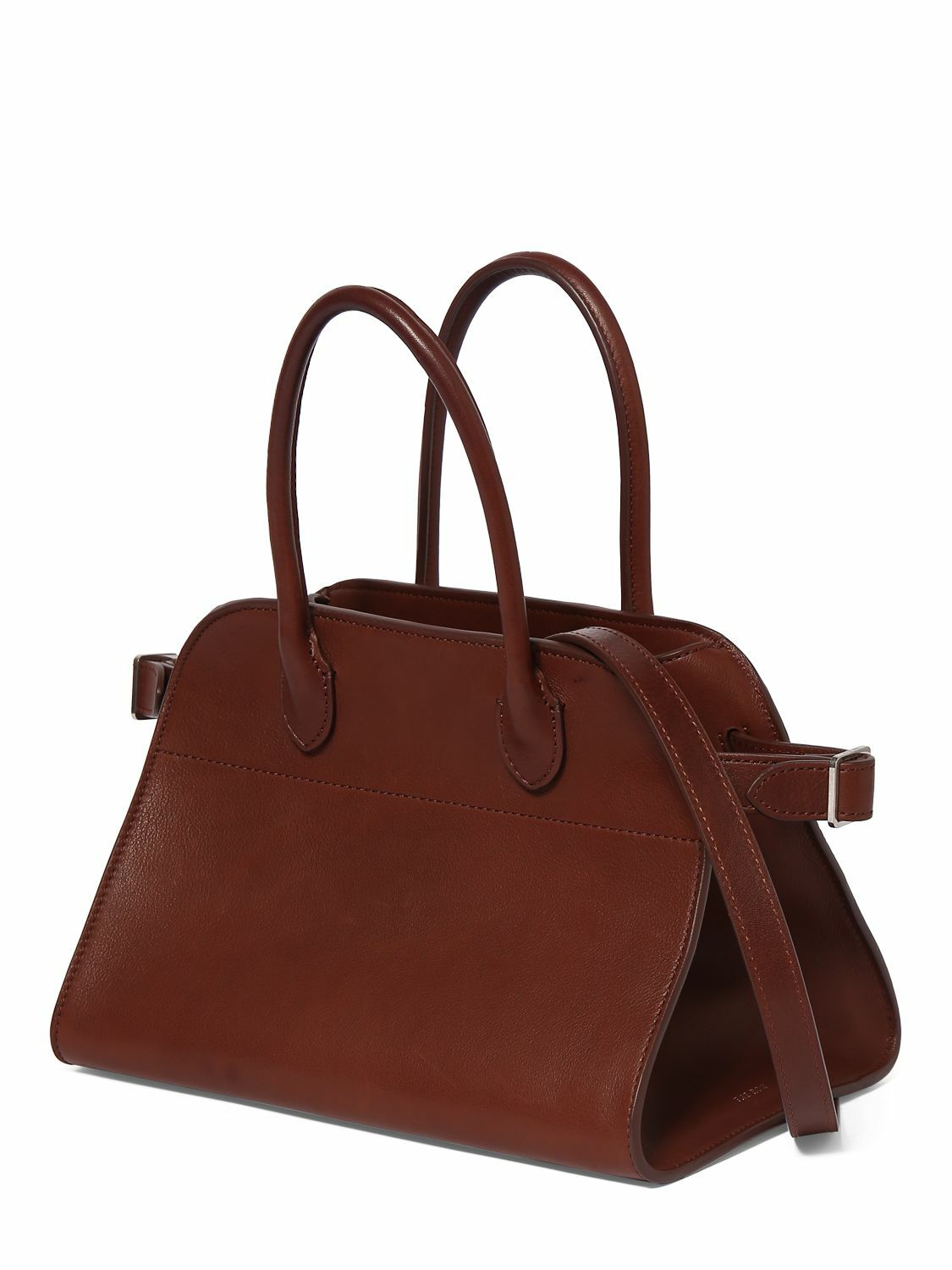
Discussions of The Row’s bags tend to start with the Margaux, the brand’s most recognized silhouette. When it launched came as an open-top tote featuring a loose, unstructured shape that photographs differently on every wearer — one reason it appeals. Less visible than Margaux are the Sofia, a top-handle bag with a firmer frame, and the Bourse, a smaller crossbody style favored for its compact, hardware-free closure. These styles are among the top row bags most frequently cited by stylists and resale platforms alike.
It’s in the construction that the bag makes good on its cost. Leather sourcing favors vegetable-tanned and semi-aniline hides, picked based on the way they develop over time as opposed to their newly-made looks. The stitchwork is deliberately understated, more often than not single-needle stitching which results in almost no visible seam. No embossed branding appears on the outside of the majority of styles; verification comes from only an internal stamp. As a result, counterfeits have become a genuine concern, and it’s part of why shoppers seek out guidance on where to buy The Row Margaux bag through vetted retailers instead of secondary-market sellers with questionable origins. The brand’s own site and a handful of approved luxury stockists stay the surest option for anyone in pursuit of a genuine item instead of a deceptive reproduction.
Bottega Veneta Bags: Woven Leather and Beyond
Bottega Veneta’s bag catalog is built around the intrecciato technique, an approach where strips of leather get woven together instead of being cut and stitched flat. The Cassette, Jodie, and Pouch styles all feature this technique in varying scales, spanning clutch dimensions up to full-size shoulder bags. Under creative director Matthieu Blazy’s tenure, which ended in 2024, the house championed padded, pillowy silhouettes that softened its previously sharper, more geometric aesthetic. His successor has kept polishing rather than reinventing, which tells you something about how conservative bag design has grown across quiet luxury brands generally.
Pricing at Bottega Veneta typically starts around $2,000 for smaller woven leather styles and pushes past $5,000 for larger totes in exotic materials. The brand additionally makes non-woven styles, such as the Arco bag, that exchange the signature weave for sculpted handles paired with smooth leather. Compared to The Row bags, Bottega Veneta’s pieces generally carry more surface texture and a somewhat youthful, trend-conscious feel, even inside a pared-back design language. While The Row draws attention to what’s missing, Bottega Veneta frequently highlights the craft of a very specific, singular detail.
Cost Levels and Resale Value
The Row’s handbags generally start near $1,500 for more compact designs and climb to $6,000 or more for exotic-leather editions of the Margaux. The ready-to-wear line runs even higher, with cashmere coats regularly listed above $4,000. Bottega Veveta’s pricing structure occupies a similar range for leather goods, though its ready-to-wear generally comes in slightly lower than The Row’s most elevated tailored pieces. Both labels steer clear of regular discounting, which helps keep secondhand values fairly steady, but an actual The Row sale is uncommon enough that shoppers view it as a real event rather than a seasonal guarantee.
Resale data from resell-focused platforms reveals The Row handbags holding onto 60 to 75 percent of initial value within the first two years, as long as the leather is kept in good condition. Bottega Veneta’s woven styles perform comparably, sometimes slightly higher for limited editions or collaborations. Neither brand discounts aggressively at retail, which is part of the appeal for buyers who see these pieces as long-term holdings rather than trend purchases. If ever a the row sale does appear, whether through the brand’s own site or an authorized department store, items sell fast, since the discount window tends to be short-lived and inventory limited.
Side-by-Side Comparison: The Row vs. Bottega Veneta
| Attribute | The Row | Bottega Veneta |
|---|---|---|
| Founded | 2006, United States | 1966, Italy |
| Flagship bag | The Margaux tote | Cassette and Jodie |
| Signature technique | Minimalist construction, single-needle seams | Woven-leather Intrecciato technique |
| Entry bag price | ~$1,500 | ~$2,000 |
| High-end price bracket | $6,000+ (exotic-leather styles) | $5,000+ (exotic/large formats) |
| Manufacturing base | Italy, a portion of U.S. production | Italy (Vicenza region) |
| Post-purchase value retention (2 yrs) | 60–75% | 55–75% |
| Design emphasis | Rooted in tailoring, bags as extension | Rooted in leatherwork, apparel secondary |
Which Brand Fits Your Wardrobe?
More often than not, the choice rests on what’s already owned and their daily style habits. Someone building a wardrobe around tailored trousers, oversized coats, and a restrained neutral palette will find The Row fashion sensibility integrates seamlessly, since the house designs clothing and bags as a single continuous idea. It was the Margaux especially that was engineered to blend into an outfit rather than call attention to itself, which is precisely why it became the go-to staple of quiet luxury dressing. If your closet staples already skew toward architectural minimalism, The Row tote bag styles will read as a natural extension rather than a stylistic detour.
Bottega Veneta suits a slightly different instinct, one drawn to tactile detail and a bit more visual interest within a still-minimal frame. The weave itself is the design statement, so someone who wants texture without logos or hardware will likely gravitate here first. Both brands reward buyers willing to research before purchasing, since counterfeits circulate heavily for both the Margaux and Bottega’s woven styles. Comparing row handbags against Bottega’s offerings side by side, in person if possible, remains the best way to judge weight, leather grain, and stitching quality before committing.
Bottom Line for 2026 Shoppers
Neither label is objectively superior; each one tackle different style needs. The Row stays the better pick for those favoring tailoring alongside bags, since its clothing and accessory lines were built to be a single unified vision from day one. Those wanting a bag-centric purchase will find Bottega Veneta more suitable with an unmistakable, well-known construction style that skips branded logos to communicate value. Price is also a factor: The Row’s entry price for small leather goods sits close to Bottega’s, but The Row’s ready-to-wear commands a noticeably higher ceiling.
In 2026, monitor the official sites of both brands, along with a small set of authorized retailers, for authenticated inventory, most notably regarding the Margaux, where demand consistently outpaces supply. Buyers researching the best row bags should compare interior stamps, hardware finish, and stitching density against verified reference photos before paying resale prices. Regardless of which brand you settle on, both represent a rare case in luxury retail where restraint—rather than decoration—is what’s truly being sold.